Latest update April 1st, 2015 6:34 PM


The Surge of Domestic Films and the Rise of Chick Flicks

By Wang Yizhi
Due to successful audience segmentation, the rate of return for medium-budget films is increasing.
Since the end of 2012, people are now no longer surprised if a film surpasses¥100 million yuan (approximately $16 million USD) at the box office. For example, the box office earnings of Lost in Thailand and So Young have both surpassed their producers’ expectations. The domestic film markets of 2012 and 2013 have experienced and will continue to experience major turning points, largely owing to a change from quantity to quality that took place in the Chinese film market around 2011. The changes that took place did not happen overnight and will be explained in the following report.
I.What is the reason behind the surge in box office earnings for domestic films?
1. The change in audiences
According to statistics released by the China Film Distribution and Exhibition Association (CFDEA), in 2009, the average age of cinema-goers was 25.7 years; in comparison, in 2012 it was 21.5 years of age. This reflects a massive jump in the number of student movie-goers. Compared with other social activities, the cost advantage of watching movies is increasing; furthermore, movies can create topics for social interaction. For the younger population who seek a sense of belonging, movie-going may be an appealing choice.
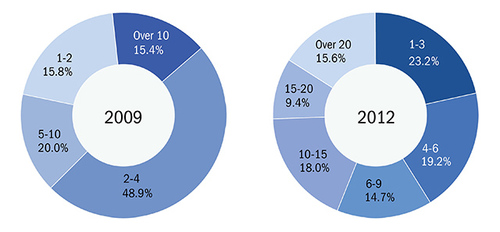
Figure 1: The change in the number of films viewed per person per year
2. The results of increasing the density of cinemas and their sphere of influence
From 2011 to 2012, the number of cinema screens in China increased by 40% for two consecutive years, which directly produced a reduction in ticket prices. Based on released statistics, due to an increase of IMAX cinemas and newly opened cinemas in the third class market, there has been gentle fluctuation in the average cinema ticket price. However, with an increase of theater franchises and the development of O2O (Online to Offline) services, such as online group purchasing, audiences in major and medium-sized cities can spend less than 30 yuan (around $4.89) on a ticket when using various discount tools. At the same time, the increase in cinemas will provide audiences with greater opportunities to watch movies in the cinema. In the top 25 highest grossing cities, audiences can find a cinema within a 30-minute radius when using public transport or within 20 minutes when traveling by car.
The factors mentioned above have all contributed to an increase in the frequency of trips by cinema-goers. According to data from EntGroup, 48.9% of audiences saw only 2 to 4 movies in 2009; while in 2012, the proportion of audiences who saw over 10 movies within a year made up 43%. This difference indicates that the expenditure on seeing a film has more than tripled, which is closely related to the increasing density coverage of cinemas.
3. The change in tastes cultivated via the repetitiveness of imported film genres
“Blockbuster fatigue syndrome” is a proper term to describe the change in consumer ideology. Generally, the imported films from January to April 2013 have struggled to compete with the success of those from 2012. In 2012, 34 imported films graced China’s screens, while in early 2013, only ‘Skyfall’ and ‘Hobbit: An Unexpected Journey’ had the visual impact expected of Hollywood blockbusters. However, even these were released long after their North American release, resulting in high definition pirate d versions flooding the internet. As a result, from January to April, male audiences readily gave up their right to choose films, demoting themselves to companions, awaiting the release of Iron Man 3.
4. Policy adjustment has changed the profit sharing structure
At the beginning of 2012, the proportion of profit from imported films increased. On 19th December 2012, the State Special Film Fund Administration Committee made several announcements, primarily stating that when annual box office revenue of a domestic film reaches a certain proportion in a theater, 5% of the special fund collected from domestic film profits will be returned to the theater. A change to the market competition structure is thus inevitable, owing to such a dramatic alteration in the profit sharing model. After the profitable policy came into effect, the number of domestic films shown in theaters surged. Last year, the premieres of domestic films barely accounted for 30% of theaters’ schedules but they have become commonplace this year.
The factors described above have caused certain phenomena to manifest more frequently in the domestic film market from January to April and these phenomena have offered domestic films better opportunities as well as many more challenges.
II.April: the rise of feminine themes
In April, feminine themed domestic films outshone others in the market. From the persistently popular ‘Finding Mr. Right’ in early April, to the strong debut of ‘So Young’ in late April, the month became the peak period for domestic chick flicks.
Figure 2: Top Grossing Films from 1st April to 28th April (Data Source: Ent Group)
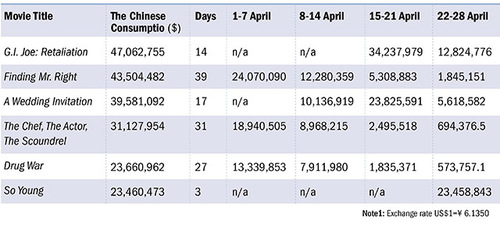
The most popular April films hint at the following trends:
1. The consumer body for genre films is expanding.
There was a 16-month gap between Sophie’s Revenge, Love Is Not Blind, and Finding Mr. Right, and their box office earnings reflect an upsurge of female audiences. Moreover, as Finding Mr. Right, A Wedding Invitation and So Young were released in quick concession, which could mark an increase in the viewing frequency of female audiences. In the Chinese market, films from a female perspective have already grown from a minority market to the mainstream market. As the number of movie viewers has expanded, the domestic film market officially entered the age of audience segmentation. This is the main reason why medium-budget films have received higher returns this year.
2. The need to schedule and strategize films in reference to emotional needs of the target audience
In China, release date for a film is typically set according to public holidays but this programming strategy can be considered quite passive for an individual film. In comparison, So Young had clearer goals in selecting its release date. Starting from April, universities enter the graduation season and so the marketing of So Young can relate more easily to the emotional fluctuations of students. Additionally, topics generated by the film also influenced parts of the working population who might be more sensitive to this period. The above factors ultimately culminated in a sense of collective nostalgia, increasing general anticipation to watch this film. The film premiered a few days prior to the Labor Day holidays to facilitate more attendance during the holiday rave. When So Young’s revenue for the first week reached a certain amount, it guaranteed subsequent scheduling of the film in cinemas.
The unforeseen delay in releasing American Dreams in China caused A Wedding Invitation to take advantage. Fortunately, this delay also prevented American Dreams in China from overlapping with So Young in terms of nostalgic theme, and its release date, 18th May (homophone for “I will be rich”), accidentally coincided with the movie’s motivational theme. Judging from the current trend, where the nostalgic trend and university graduation season still persists and where Zhao Wei has become a symbol of self-improvement, the motivational themed film American Dreams in China is likely to gross over 300 million yuan (around US$48,899,756) in May. Drug War seemed hasty in its scheduling: the film is obviously more suited for the summer holidays than Qing Ming Festival (China’s “Tomb-Sweeping Day”) .
3. The Matthew Effect in film distribution
In recent years, many films experienced the “one-day tour” to cinemas. It is not unusual that screening sessions for premieres take less than 10% of the schedule, and this situation will only intensify in 2013. After years of experience in the market, theater managers have increasingly acquired better judgment of the marketability of films. Theaters can also make more meticulous arrangements for the movie screening schedules. As a result, there will be more films whose premiere sessions fall below 3% of the whole schedule, or even lower. Film distribution has slowly moved away from relying on favors and personal relationships towards an age of competing for terminal execution. For the sake of profit, theaters will actively promote films that have the potential of performing well at the box office. From this perspective, the distribution team of Enlight Media Group possesses a definitive “first-mover” advantage.
4. Whoever masters new media, will dominate the box office
As the average age of the audience population becomes increasingly younger, new media has become the primary battlefield for film promotion. So Young followed Love Is Not Blind and used SoLoMo (Social, Local, and Mobile) marketing. From traditional one-way coverage to two-way interactivity through new media, not only does the promotion of So Young consist of various creative touches for delighting the audiences but also persistently strives to captivate its target audience.
Figure 3: Baidu Search Volumes for Three Chick Flicks in April
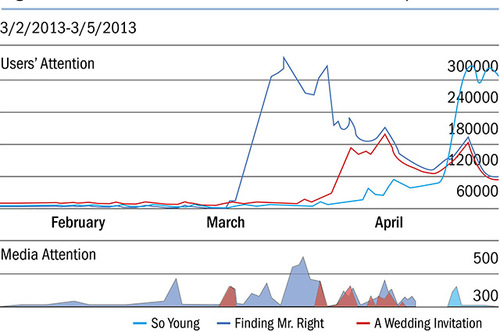
Figure 4: Hot Words on Sina.com
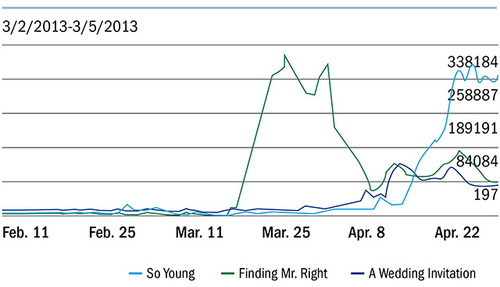
If the three chick flicks are taken as examples to analyze changes in the new media index, the marketing efforts for So Young started much earlier than Finding Mr. Right. However, media attention for So Young during its early promotional period was not superior to the other two films and even seemed somewhat feeble in comparison. Due to the director’s strong social network and the initial less-than-generous marketing budget, the promotion of So Young turned out to be more like an organized social media rehearsal and failed to establish close relations with traditional media, such as publications or websites.
In terms of box office results, Finding Mr. Right took advantage of the audience’s need for commercial films with feminine themes. In recent years, some domestic films have imitated the Hollywood chick-flick genre, but none could surpass Finding Mr. Right in quality and detail. In comparison, the strong box-office performance of A Wedding Invitation can largely be attributed to its uncontested schedule. As Drug War released early and American Dreams in China and Django Unchained were both delayed, A Wedding Invitation enjoyed a near-monopoly at the cinemas.

So Young could be referred to as a marketing case as it exuded a strong commercial intention, reflected from its content, marketing, cast and even the production crew. As a budding director, Zhao Wei has similar business sensitivity as that of Xu Zheng. Such commercial awareness in directors is still a rarity in the current domestic film market.

Related articles




More in this category












People
-
 Zhou Quan Talks About The Golden Horse Film Academy Photo credit: GHFA Director Zhou Quan writes about his...
 -
 Sesame, open! by Xu Jia “Our proposition is simple: we want to help...
 -
 AFI Graduate New Talent Zhou Quan Photo credit: Each Other Films Born in a renowned ancient...
 -
 Amber’s Adventures in Wonderland Sensitive and translucent, Amber KUO Tsai Chieh started her...
 -
 Dennis Liu the Genius By Xu Jia I ran into director Dennis Liu’s work thanks to...
Don’t Miss
-
 Now Official: The Lionsgate and Hunan TV & Broadcast... CHANGSHA, March 18, 2025 - Lionsgate (NYSE: LGF), a...
 -
 BAFTA Announces Scholarships To Aid Chinese and British... Support to study film, television or games, in the UK and...
 -
 Fang Li: Producing Quality Films As A Pleasure Fang Li built Laurel Industrial Company Inc., an earth...
 -
 Bridging the Dragon – Starting in Berlin BERLIN Feb 10, 2026 – Launched by producers for...
 -
Zhou Quan Talks About The Golden Horse Film Academy Photo credit: GHFA Director Zhou Quan writes about his...