Latest update October 21st, 2015 12:41 PM


Co-production 2013: Never Made Easy

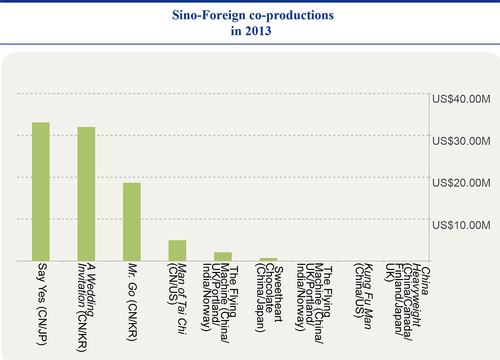
China has signed co-production treaty with Canada, Italy, Australia, France, New Zealand, Singapore, Belgium and U.K., soon with South Korea. The Chinese film market seems to become more open and tolerant, but culture and economic interests stand in the way.
In early 2012, quota on revenue-sharing imported (RSI) films was increased from 20 to 34 since China and U.S. reached a new deal, and the revenue share ratio for foreign films also rose from 13% to 25%. All of sudden, local films were overwhelmed as imported films accounted for 60% of the total B.O. revenue during the first three quarters in 2012. Feeling compelled to protect local films from such fierce competition, Chinese government deliberately stipulated quota for co-productions based on Rules for the Administration of Sino-Foreign Film Co-Production (2004) and then contained those Hollywood B.O. hits which intended to be released as co-productions instead of RSI films.
New rules requires that in each co-production, there should be no less than one third of the investment should come from China; Chinese actors should take at least one third of the leading roles; both parties should involve in scriptwriting; the story should be closely related to China, and it must include Chinese locations. Therefore, even though many Sino-foreign co-production treaties were signed, in recent two years, the number of qualified co-productions was on a decline.
1. New partner in the East
When Hollywood blockbusters Iron Man 3 and Expendable 2 were disqualified from co-productions and competing with each other, Chinese investors turned their attention to another partner—-South Korea, whose filmmaking technology currently tops in Asia. Among the top 5 highest grossing Sino-foreign co-productions in 2013, three were co-productions with Sino-Korean: modern romance A Wedding Invitation (Oh Ki-hwan, 2013), baseball-themed Mr. Go (KimYong-hwa, 2013), whose theme was popular in South Korea but quite a virgin territory in China, and animation Pororo, the Racing Adventure (Park Yeong-gyoon, 2013). The thing is, the Chinese government has been supporting local animations for several decades, but they are still weak. Bunshinsaba 2 (Ahn Byeong-ki, 2013) ranked the No.1 highest grossing local horror film, and it was invested by Chinese companies (therefore a local film) and produced by Korean filmmakers. This film included: it seemed that Korean filmmakers has made great achievements in China this year.
Market share of countries that had co-productions with China in 2013
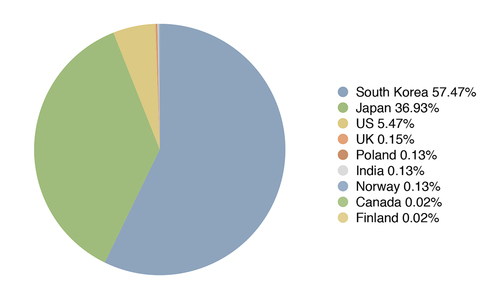
China, Japan and South Korea have a lot in common in popular culture, fashion styles, family values and attitudes towards love with mutual influence, due to geographical connection and historical origins. Young Chinese love Japanese anime, Korean TV dramas and their pop stars. Much online slang comes from Japan and South Korea. It is easier for Japanese and Korean filmmakers to overcome cultural and narrative barriers than their European and American counterparts, so their works are more acceptable in China. Besides, audiences are familiar with some Japanese and Korean idols as recently they have frequent roles in Chinese films or TV dramas.
Compared with Japanese films, which were popular for its artistic merit during the 1990s in China, Korean films, which started to rise in the beginning of 21st century, have bigger ambitions and more experiences in making genre films. Korean directors always have stronger personal styles and they have better technological teams at reasonable prices; Korean stars have a larger number of teenager fans in China. Additionally, Sino-Korean co-operation faces fewer risks of being swayed by political issues. All in all, South Korea seems to be China’s best partner for making commercial films in terms of culture and profits.
However, equal allocation of production rights in a co-production has led to film project positioning. These Sino-Korean co-productions all had Korean directors, Chinese distributors and Korean production teams. China dominated casting while Korea played a larger role in the story.
A Wedding Invitation and Say Yes (Leste Chen, 2013) both starred Taiwanese idols, but the later did better in meeting audiences’ demands for romance. Sino-Japanese co-production Say Yes featured a single woman who exceeded the average age for marriage, while A Wedding Invitation was a typical Korean “pure love story”. Although A Wedding Invitation created a new record for Sino-Korean co-production with nearly $33 million, it only ranked No.2 on the list of Sino-foreign co-productions, grossing $1 million less than Say Yes.
Huayi Bros. and Korean company Showbox co-invested in the No.3 Sino-Korean co-production—-Mr. Go. This film mainly targeted at China, but it was about baseball that has a mass base in South Korea but is less appealing to the Chinese. The premise was wrong at the first place, and it was a failed attempt as a South Korean “export”.
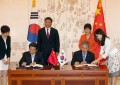
After China and South Korea officially sign a tentative cooperation agreement in movie and TV production, their collaboration would be more regulated and even closer. Compared with Hollywood, Korea will be the best collaborator and the most competitive rival for China in the next few years.
2. Filmmakers from the wild West
In Europe and U.S., there is no lack of outstanding filmmakers and rich filmmaking experiences, but they just cannot overcome the cultural barriers and then master these small-budget “twee” films like Japan and Korea did.
Even though there is a great co-production project, it is not always possible to do effective marketing. China Heavyweight (Yung Chang, 2012), the Best Documentary winner at the Golden Horse Awards, had a shy performance at the box office in Mainland. If co-productions expect to cultivate diversified audience groups, they should work on marketing and film promotion rather than feeding audiences with some genre films that local or Asian films are much better skilled in.
Chinese audience does not have much appetite for “westernized Chinese food” – Chinese kung fu packaged with western technology. If the failure of The Karate Kid did not arouse investors’awareness of this issue, disappointing performances of both Man of Tai Chi and Kung Fu Man should be convincing enough: Chinese audiences just do not buy it, even though it is a Keanu Reeves film.
Furthermore, Sino-western co-productions generally hire B-list or C-list European and American directors. The booming Chinese film market lacks talents, and it is difficult to find veteran Hollywood directors due to the limited production scale, thus leaving much room for those more available directors to stand out.
Director Dennie Gordon mainly made TV series in U.S., but she became popular in China due to her co-production film My Lucky Star starring Zhang Ziyi and Wang Lee-Hom. Nick Powell, Outcast’s director, in fact, worked as an assistant director in Hollywood for many years. Directors like Chuck Russell finally found investments for his Arabian Nights here in China, Roger Donaldson undertook Heart of Darkness and Sergey Bodrov was selected to direct Queen of war: these three have not made any memorable film for years.
Investors appreciated those directors for their backgrounds without exhaustive investigation into their execution abilities. As for those directors, they did not have adequate experiences in working in China or even directing medium-budget or big-budget films. Some Chinese distributors chose them for works they participated in or finished years ago. The greater expectation audiences have, the deeper disappointment they would get. After a few times, audience have their own judgment, and some “co-production” projects were immediately labeled as “unworthy of watching” as soon as they were announced.
It seems that Transformers 4, Pacific Rim 2, Kung Fu Panda 3 and Revenge 2 might be able to restore the reputation of Sino-U.S. co-productions provided that if they could all pass the examination for “co-production” qualification.
At the same time, Mainland-Hong Kong co-production has revived.
3. Old friends in Asia
Hong Kong films reached low ebb due to a shrinking market in 2003, while film industry in the Mainland was listless; therefore, Hong Kong and the Mainland decided to join hands to resist foreign films. Mainland-Hong Kong co-productions soared under CEPA. In the last ten years, Hong Kong directors like John Woo, Hark Tsui, Peter Chan, Lau Wai-keung and Gordon Chan etc. came to Mainland with their expertise, helping to force a revolution of Chinese films.
8 Mainland-Hong Kong co-productions ranked among the top 10 highest grossing Chinese films in 2004. The success of Seven Swords by Hark Tsui (2005), The Warlords by Peter Chan (2006), Painted Skin by Gordon Chan (2009) and Bodyguards and Assassins by Teddy Chan (2009) strengthened Hong Kong directors’ resolve to enter the Mainland market. Later, a stable cooperation model was formed: Hong Kong directors make films with stars from both regions and investment from the Mainland.
Genres of Mainland-Hong Kong and Mainland- Taiwanese co-productions in 2013
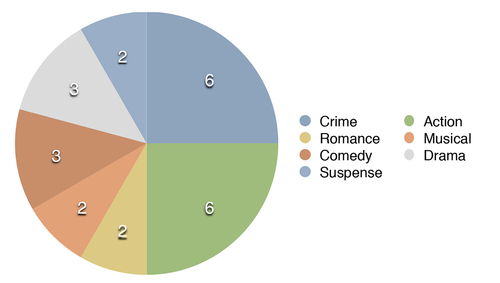
However, the development of Sino-Hong Kong co-productions was hindered due to the short of diversified themes and failing at pleasing local audiences. Hong Kong directors were not familiar with the lifestyle in the Mainland and audiences’ tastes, while investors were not willing to take risks. As a result, Sino-Hong Kong co-productions were limited to the genres of martial arts and action films: the directors were famous for during Hong Kong films’ golden era. Furthermore, they felt constrained due to censorship, even if dealing with their most familiar topics. Consequently, audiences who expected to watch localized films and movie-goers who would like to see the special style of Hong Kong films were both disappointed.
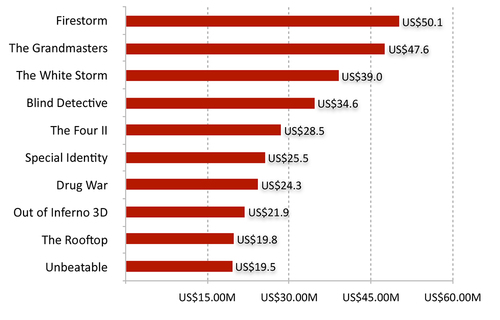
When people are arguing whether the CEPA has saved or destroyed Hong Kong films, Hong Kong directors have completed the transformation from making “B.O. hits with negative reviews” to making “high-quality B.O. killers” after periods of adaptation. The Grandmasters, No. 2 highest grossing Sino-Hong Kong co-productions in 2013, was nominated for Oscar’s Best Foreign Film; The White Storm (No. 3) by Benny Chan, Blind Detective (No. 4) and Drug War (No. 7) by Johnnie To as well as Unbeatable (No. 10) by Dante Lam all gained a score more than 7/10 on Douban.com. This was totally different from the situation in 2004: Sino-Hong Kong co-productions were nothing but of poor-quality. Even though Mainland-Hong Kong co-productions were still limited to certain genres,
Wong Kar-wai, Benny Chan, Johnnie To and Dante Lam adapted to the environment and brought their artistic merit and personal styles from Hong Kong films into these Sino-Hong Kong co-productions. Crime-themed film Drug War involving with Mainland police has been regarded as the paragon of high-quality Sino-Hong Kong co-productions in recent years.
Mainland-Hong Kong or Mainland-Taiwanese co-productions grossed more than $16 million in 2013
Currently, foreign production team is mainly responsible for making the Sino-foreign co-produced film, while China provides investment, cast and temporary workers. In the last ten years, it was Sino-Hong Kong co-productions that helped Mainland filmmakers to acquire skills to make genre films, and they imported the concept of marketization. Hong Kong directors who proceeded north from the “eastern Hollywood” cultivated creators such as cinematographers, art designers and action choreographers in the last ten years; in the future ten years, they will still be the vanguard of exporting Chinese films to the rest of the world.
Taiwanese films revived in recent two years, and they brought more diversified genre to Chinese films. For instance, The Rooftop, Jay Chou’s musical film that gathered Mainland, Taiwan and Hong Kong filmmakers, grossed $16.5 million. There seem to be a tendency of films co-produced by the Mainland, Taiwan and Hong Kong: Taiwanese and Hong Kong filmmakers provide ideas, production team, execution and management of production, while the Mainland will act as the production base and target market.
In conclusion, among the 9 nominees for Oscar’s Best Foreign Film, France took 5 places, including The Grandmasters. France’s co-production attitude is: to support films of national diversify based on their artistic merit – while China has a different idea. China now fights for both commercial interests and cultural export. In the past, a small amount of investment into the film would make it a co-production as local commercial films were short of budget. With the increase of RSI quota, the short cut to take a share in the market as a co-production has been strictly supervised year by year.
Hollywood’s core strength has been shut out of the Chinese market due to the new rules on co-productions. Dreams of Dragon Pictures Co. invested $10 million into Cloud Atlas, the biggest budget that Chinese investors could ever take risks for; unfortunately, it was disqualified from a co-production after the implement of new rules. This film is claimed to be “the biggest-budget (over $100 million) independent film in history”, as it should receive $30 million investment from China to be a qualified co-production according to regulations. Such amount of budget far surpassed the costs of a local blockbuster (the B.O. champion in 2013, Journey to the West: Conquering the Demons, was merely $26 million), so Chinese investors do not have the courage or do not have to take dual risk to make a “co-production” with such a big budget.
Although this approach could protect local films in the market for some time, it has nullified many foreseeable co-production projects. Modest investors in China continued stepping back in order to hold up the local market, and neglect cultural export. All in all, 2013 was a “lose-lose” year for co-productions, no matter from the commercial or the cultural perspective.

Related articles



More in this category


One thought on “Co-production 2013: Never Made Easy”
Leave a Reply






People
-
 Stars Rising From Hunan TV BEIJING July 15, 2025 - Hunan Satellite...
 -
 Beijing Culture Hires Veteran Xia Chen’an To Head The... BEIJING July 1, 2025 - Beijing Jingxi Culture &...
 -
 Zhang Ji, the Screenwriter Writing A Film About Tennis... Always try new genres is my best way to dig deeper in...
 -
 Veteran Screenwriter Shu Huan Talks About Screenwriting In... Shu Huan is the screenwriter of LOST IN THAILAND, a story...
 -
 China’s Top Screenwriter Zhou Zhiyong Looks Forward... Some day, we are going to write films with Hollywood...

Thank you, I’ve recently been searching for info approximately this topic for a long time and yours is the best I have came upon till now. However, what in regards to the conclusion? Are you certain concerning the supply?|What i don’t realize is if truth be told how you are not really a lot more well-appreciated than you might be right now. You are very intelligent.