Latest update December 15th, 2015 10:12 PM


Nuts and Bolts of the China Co-Productions: Focus Korea
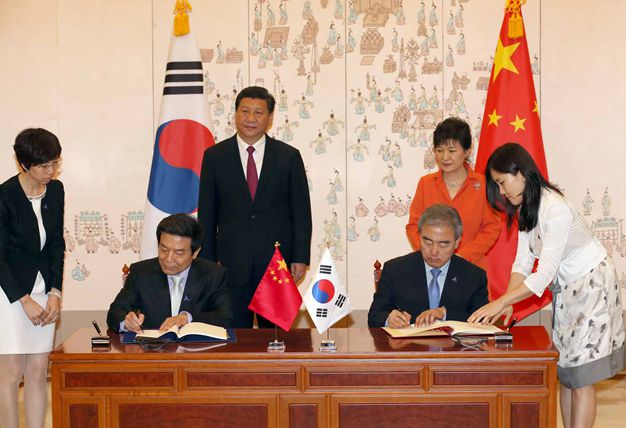
The Minister of the Ministry of Culture, Sports and Tourism (MCST), YOO Jin-ryong, and Minister Cai Fu CHAO of China’s State Administration of Press, Publication, Radio, Film and Television signed the Agreement Between the Government of the Republic of Korea and the Government of the People’s Republic of China Concerning the Co-Production of Films on July 3rd, 2014.
By Allen Wang & Jesse Weiner
The annual quota for the screening in mainland China of foreign revenue-sharing films remains at 34 (mostly Hollywood blockbusters) and another 30 to 40 mid-budget foreign films sold into China on a flat-fee basis. China might increase quotas for imported films by 2017 as part of World Trade Organization talks.
China’s film market is posed to break records again this year with the theatrical box office hitting $2.2 billion (13.4 billion RMB) in the six month period ending in June (a 22% increase from the same period last year) and with estimates of close to $5 billion for the whole of 2014. At the six-month mark, 2014 has seen imports account for 53% of the market. Movie screens are also still being built at the incredible rate of approximately 10 to 13 each day. China had 18,200 screens at the end of 2013 — compared with 40,000 in the US – and would need about 133,000 screens to have the same number of screens per capita as the US. It does not appear, therefore, that the massive growth of the market will be losing steam anytime soon.
Main Considerations on Chinese-Korean co-productions
In fact, the first major consideration is the choice of a co-production partner. When choosing that partner, the Korean producer is strongly advised to perform at least basic due diligence to fully understand the potential partner’s movie investment, distribution, production (especially, co-production) experience and history, level of capitalization, level of connectedness to Chinese media outlets and movie regulatory authorities, etc. In any event, non-disclosure agreements and memos of understanding should also be signed at the outset to avoid intellectual property misuse/appropriation issues.
The choice of film script is surely also of utmost importance. As per Chinese regulations, the film script must possess Chinese elements and some amount of the film must be clearly shot in China.
The Co-Production Contract
While the memo of understanding or letter of intent that should have been signed at the beginning of negotiations between the producing parties stipulated the most basic terms of the deal, the co-production contract will spell out those terms in much greater detail (in hopes of avoiding later misunderstandings). Some of the main considerations for the co-production contract are as follows:
- Territories. The parties are advised to spell out clearly their respective rights (including the collection of box revenues) in specified territories and time.
- Project Approval. A project would be non-existent if it fails to be approved as an official co-production.
- Credit. In China, it should be noted that regulations stipulate that it must be the Chinese producer that receives the “Presented by” credit in the first position.
- Intellectual Property. It must be clear stipulations for how the copyright may be used in different territories and who will be able to profit from derivative and ancillary rights.
- Production Company and Fees. For China-Korean co-production projects, if it’s the Korean side that shall undertake the actual production/shooting, the fees for such services may follow the customs of South Korea. Moreover, it can also be agreed how (i.e., the manner and priority in the revenue waterfall) net profits will be distributed to the relevant parties.
Censorship
It should first be understood that there is no movie rating system in China; censorship can therefore be seen (at least to some degree) as an alternative method to ratings. In practice, there are three topic areas that are considered most sensitive: political, national values, and historical fact. That is, the ideas of films must ultimately convey positive power to society, and which will not engender conflicts or societal unrest. Additionally, sympathy cannot generally be afforded to the evil ways of human nature, and the “evil wins” scenarios are likewise unacceptable. A film can pose acute questions (societal or otherwise), but must also give people the hope to solve the problem.
The authority in charge of censorship is SAPPRFT. The first round of censorship will be the review of the script for the obtaining of the Film Shooting Permit (review should be completed within 20 work days). The second (and final) round of censorship is the review and assessment of the content and technical aspects of the completed film (this review should be completed within 30 work days) to obtain the Public Screening Permit.
Those films that ultimately fail in passing censorship are mostly those that involve themes of eroticism, superstition, excessive violence or those that take a “wrong stand” on political issues. It should also be noted, however, that it’s only very rarely that a script or completed film will receive a non-recourse failure notice. That is, changes to the project will often be called for, and the producers will then have the chance to make such changes, as need be.
Tax
Tax issues can seem complex, and even more so when dealing with cross-border entertainment transactions. It’s surely advised to consult with legal/tax professionals on specifics of your deal. A simple overview on two main aspects of tax in the China film business follows.
Box Office Calculation Bases
Begun in 2004, computer software that tracks the box office numbers is now supposed to be installed in greater than 95% of Chinese cinemas, data from which forms the basis for the most accurate calculation of China box-office revenue.
The taxes applied to such overall box office ticket sales include: 1) the “Special Film Fund” tax of 5% (used to support the making of special-themed films and to support the renovation of movie theaters) and, 2) a Value-Added Tax (VAT) of 3.36% (also applied to 100% of ticket sales). After deduction of the two aforementioned items, the remaining box office amounts will be allocated according to agreements between the theater (chain) and the production/distribution companies.
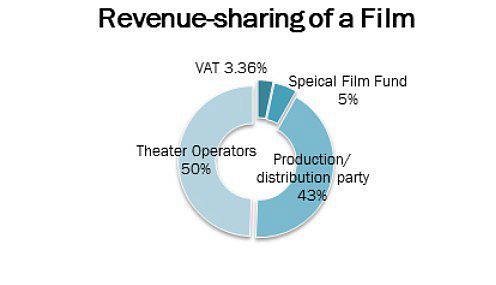
For a purely domestic film (or flat-fee imported film) the Chinese production/distribution parties may collect approximately 43% of the box office, with the cinema chain company collecting 7%, and the theater operator collecting no more than 50% (as per SAPPRFT rules). For an import that is of the revenue share variety the proportion of revenue shared among the foreign producer, the Chinese distributor, and the cinema (chain) is generally 13:35:52, respectively. (When the foreign producer is a US company the proportion is adjusted to 25:30:45, as per a deal struck between the US and China in 2012.) Based on different market expectations for particular movies, revenue share of the box office can (and does) often fluctuate.
China-Korea Agreement on Co-Productions and Recent Projects
After a tentative film co-production agreement was signed last year, China and South Korea signed a full film co-production agreement on July 3, 2014, which will give joint productions domestic film status, thereby avoiding China’s quota limitations for foreign films. However, as approved co-productions are generally treated as domestic films anyway, the true advantages of such an agreement will need to be evaluated in the future. The agreement does allow for somewhat more leeway in the contributions of each party in the way of main talent and financial commitments versus ordinary co-productions. But the main advantage for now may simply be that the imprimatur signifying strong government support for co-productions will likely encourage Korean stars and directors to work in China and attract more investment and resources from the Korean film industry to China, in additional to increasing Sino- Korean co-operation in special effects and craft exchanges – at a perfect time, too, when larger-scale Korean productions aimed at China are on the rise.
That is, while initial China-Korean cooperations beginning in 2000 provided dismal box office results, recent co-production successes, such as A WEDDING INVITATION (CJ E&M and Beijing Century Media) and MR. GO (Showbox/Mediaplex and Huayi Brothers), along with the “Korean Wave” of popular South Korean culture hitting China hard over the past several years (note the incredible success of TV drama MY LOVE FROM THE STAR), and the future of Korean films and dramas in China seems brighter than ever.
Allen Wang and his team are based at the Yingke Law Firm headquartered in Beijing. Korean Film Council (KOFIC) is one of Allen Wang’s clients.

Related articles




More in this category