Latest update December 15th, 2015 10:12 PM


Zhou Quan Talks About The Golden Horse Film Academy
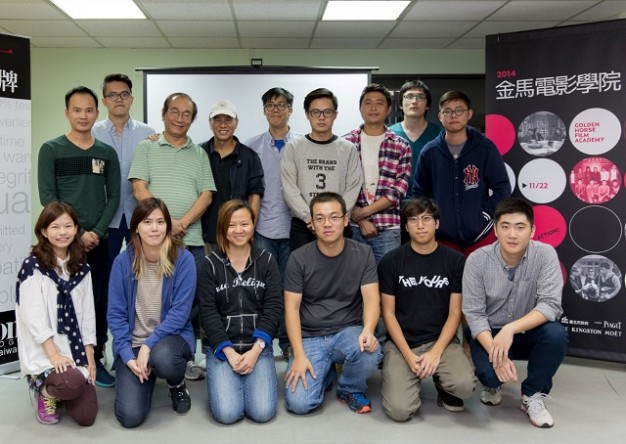
Photo credit: GHFA
Director Zhou Quan writes about his experience at the Golden Horse Film Academy and how it helps him to find the invisible emotion and truth for his story
Working with Chinese filmmakers of diverse culture background and training in different film education systems was a fruitful experience. Learning from the masters was invaluable and would benefit my entire filmmaking career. Last but not the least, living in Taipei for a month, eating local cuisines, experiencing and appreciating another version of Chinese history and culture was such an incredible and unforgettable memory. I am sincerely grateful for all the wonderful memories that GHFA brought me.
After 6 years of media studies in Australia and 3 years of filmmaking training in the United States, I wanted to seek a pathway and platform to integrate myself into the Chinese language cinema. I was also eager to further expand my horizon for Asian and World cinema from the distinguished local filmmakers: the Golden Horse Film Academy was my first choice to start my exploration.
GHFA is the only educational program and workshop attached to a major film festival and award ceremony in the Chinese-speaking region dedicated to training the next generation of Chinese filmmakers. It was founded and has been led by the world- renowned filmmaker Hou Hsiao-Hsien since 2009. The program is run by Hou’s long time collaborator and legendary editor Liao Ching-song. Since its inception, every year Hou and Liao choose two established younger Taiwanese directors to supervise the selected talents to produce one or two short film(s).
All Mandarin-speaking writers, directors and cinematographers under the age of 35 who have finished 2 short films are eligible to apply. I submitted my college and graduate thesis films: WHEREABOUTS (2011) and WOMAN IN FRAGMENTS (2013). In my personal statement, I specifically talked about Director Edward Yang and his masterpiece YI YI: A ONE AND A TWO’s influence on me. YIYI gave me the first impression of modern Taipei, not only the society but also the people living in it. It drove my curiosity to explore Taipei and its culture.
On September 12th, 2014, I received a notice from GHFA that I made it. I could not express my excitement and expectation enough.
Two weeks later, GHFA delivered some messages to us. One of them was the change in the rules of the productions: Dean Hou announced that the theme for 2014 was “literary adaptation”. The Academy presented us four short stories from novelists Sabrina Huang 黄丽群 and Essay Liu 刘梓洁 to choose from. They also announced that Directors Arvin Chen and Lien Yi-chi would be our production mentors.
There would be two production groups in 2014. Therefore, we had to decide one story from each writer. The stories we chose to adapt were AFTER LASIK 镭射 by Essay Liu and THE CABIN OF SEASIDE 海边的房间 by Sabrina Huang. I was assigned to the group of AFTER LASIK and Lien Yi-chi was the mentor of my group.
Each group had four writer-directors and two cinematographers. Among the 12 of us, there were six from Mainland China, three from Taiwan, one from Hong Kong, one from Singapore and one from the U.S. Both groups shared the same producer, the production designer, the costume designer, and the ten-time Golden Horse Award winner Tu Duu-chih’s sound post production studios.
The GHFA producing team started pre-production immediately after the stories werechosen. They went to location scout based on the information depicted in the short stories and sent us pictures of the potential locations. At the same time, the costume designer delivered the basic stretches of the main characters via emails.
After the complex visa application, I eventually boarded the flight to Taipei on October 24th 2014, excited and anxious. The last time I made a Chinese language film was over five years ago in Shanghai. However, I could not repress the feeling of anxiety because I was not familiar with the production environment in Taiwan. Also, I was very used to working with AFI filmmakers in a certain way during last three years. It was a safe environment for me. I was not sure how well I could mix with the new friends.
When most of us arrived, we gathered in the Golden Horse Executive Committee’s office in the evening. After a round of brief introductions, Dean Hou made a moving speech on the truth of cinema to welcome us. He talked about his experience of casting non-professional actors for A CITY OF SADNESS and his observation of AMOUR to illustrate the importance of truth in filmmaking. Truth is the basis of dramatic storytelling and the boundless possibilities. Followed by Dean Hou’s heartwarming speech, Chief Administrator Liao Ching-song encouraged us to read and comprehend the short stories as deeply as possible and find the hidden messages and the invisible emotions behind the words.
Making a film with three other directors and two cinematographers in a month was a brand new experience to all of us. It was also a tough task. It requires high volume of participation and communication from every single member in the group in each stage of production.
We had a chance to talk to the writers of the short stories about the characters, theme and motif, and the tone for our respective story. Afterwards, we started working on the scripts. There were 5 rounds of script writing. Every time we finished a draft, we voted for the best version to move on to the next stage. While we worked on the script development with our hearts and souls, the producing team organized location scouting and arranged casting sessions for us.
Every director had his or her specific vision for the film. Our respective visions showed in our scripts and casting choices. These diversions led us to many long and intensive arguments. When there were only two days left before the principle photography, we had split the work in order to be better prepared. A Taiwanese director and I finalized the shooting script, while the other two directors selected wardrobe with actors.
There were 4 days of production. While each director was in charge of several scenes assigned by our mentor, the two cinematographers each shot two days of the production. Even though we didn’t have sufficient time for pre-production, luckily, Hou’s crew from NIE YIN NIANG聂隐娘 supported us throughout the production. I experienced the difference between Hollywood and Taiwan’s filmmaking community. Hollywood is highly industrialized in terms of its strict workflow and its high degree of corporation and communication among different departments, while Taiwan encourages directors to improvise on set. I was given more freedom to make creative changes and received unconditional support from my crew. It was an eye-opening filmmaking journey for me.
During post-production, we had many editing sessions with Liao Ching-song. Editing with Liao was the one of the most valuable moments for my GHFA journey. Liao would watch all the dailies. Then, he would trim a few frames here and there, and select some different shots to replace what we had. Thus, a better film came out! He’s just a magician! When we asked him for his secret recipe for editing, he said there was no shortcuts nor secrets, we just had to watch what we shot over and over again and tried as many different combinations as we can until we found the perfect matches. In another words, we have to find the invisible yet true emotions inherent in the scenes.
We showcased the two short films to the public as part of the program of Golden Horse Film Festival. The new Chairman of Golden Horse Film Festival Executive Committee Sylvia Chang attended the screening alongside Hou and other established filmmakers. Ms. Chang was sitting right behind of me. I was nervous through the entire night until Hou acknowledged us by comparing the atmosphere of the screening to the age of Taiwanese New Cinema. I was thrilled to hear his comments.
Besides the short film production, GHFA also organized several master classes for us from Director Hou, Director/Cinematographer Chienn Hsiangand Production Designer Yau Wai-ming. They generously shared their insight in cinema, and their understanding and observations for the Chinese-speaking film industry with us. We also had the honor to be invited to attend the ceremonies and galas of Golden Horse Film Project Promotion and Golden Horse Awards.

Related articles



More in this category