Latest update April 1st, 2015 6:34 PM


Paris Image Cinema - Industrie du rêve: The French Connection
Reported by Vicky CHEN, edited by Ninja Tsui
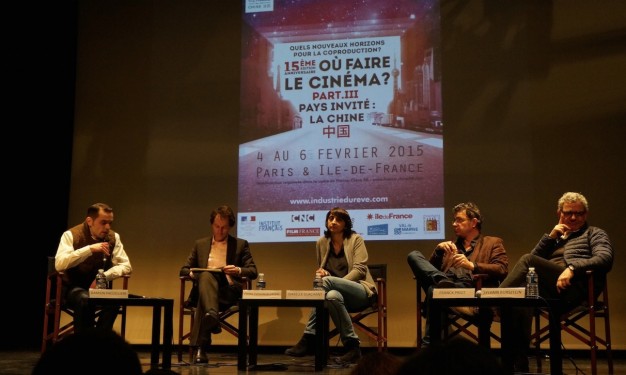
PARIS – Feb. 4, 2015 Paris Image Cinema - Industrie du rêve launched a Chinese-French coproduction day of 3 forums today in Maison des Cultures du monde.
Guests include Pierre-Emmanuel Lecerf, director of European and International issues of CNC; producer Isabelle Glachant, head of the China office of Unifrance; Franck Priot, Deputy CEO of Film France; producer Carole SCOTTA, head of Haut et Court; Vincent Wang, Tsai Ming-liang’s longtime producer; director Philippe Muyl and Wang Chao, etc.
These professionals talked about their Chinese-French coproduction projects: different focuses during the creative process, difficulties in funding, cultural shock and efforts to comprehend different working styles and approaches.
Today, France is the second largest film exporters and the third biggest film market in the world. And Sino-French co-productions are not really alien for the Chinese market.
Sino-French coproduction: strategic partnership since 2010
Since the official signing of coproduction agreement between China and France in 2010, Chinese-French collaboration in filmmaking is on the rise. The Chinese-French cooperative relationship, based on a strategic win-win pursuit, has been closer than ever.
The French cinema professionals never hide their desire to promote their filmmaking talents in a larger international market as well as their demand for more funding sources, while what they have in their own territory is too limited to make their ambitions come true.
Meanwhile, the Chinese film industry, with an annual growth of 30% per year, is in urgent need for film techniques and talents.
Most importantly, coproduction films are not restricted by quota restrictions, thus producers could obtain 43% box office profit sharing. But in the case of imported films, the box office income sharing of the foreign producers is only 25%. Also, coproduction becomes an efficient way to make the Chinese film market accessible to global filmmakers.
The French cultural exception is a unique way of protecting the French national cinema. The French National Cinema Center (CNC) performs its duties in promotion of co-productions between China and France and every year it offers subventions to support the funding of Franco-foreign productions.
To satisfy the criteria of CNC, the coproduction has to strictly conform to a scoring system, which concerns the choice of language, filming locations, French nationality of the director, producer, and actors and also the team of technicians. Apart from the national help of CNC, other official organizations such as Unifrance and Film France also assist and improve the development of Franco-foreign coproduction as well as their promotion missions.
In contrast, Chinese-foreign coproduction stays more commercialized and liberal-capitalist. The prerequisite of everything possible is to abide by the SARFT rules, among which the Principal of 20-80 is basic.
The forum speakers said today that without a foreseeable commercial market interest in the project, it’s always difficult to accomplish funding process in China. Investments have more often been poured into entertainments commercial productions, like Hollywood style movies – to cater for the appetite of young Chinese audiences, who makes up the majority of its film market today.
Nevertheless, when asked “how the French filmmakers should adapt themselves to a more commercial demands but less artistic personal expression in coproduction project”, French producer Sylvain Bursztejn insisted that the artistic talents, creativity and mature experience of French filmmakers and their persistence on movies quality are their unique assets in international cooperation, despite the great influence of American commercial movies. “The Chinese film industry needs real professionals and is keen to have more exchange of experience in filmmaking; that’s what we French do have. ”
In addition, he commented that the landscape in France, like castles and chateau, even the romantic imagination about French people and French culture make bonus points for Sino-French coproduction.
Chinese-French Coproduction: Working the French and the Chinese together … it’s not easy!
Despite challenges and difficulties in Chinese-French coproduction, the Chinese media still claimed that in 2014 Sino-French film coproduction has entered its “honeymoon period”.
In 2014, THE NIGHTINGALE, directed by Philippe Muyl, has represented China to compete for Oscar’s Best Foreign Movie; Luc Besson’s LUCY has won a great success in box office in China.
Although LUCY is not a coproduction project, Luc Besson is undoubtedly one of the French directors who have the closest partnership with Chinese film industry. His company Europacorp has established a long-term partnership with Chinese film company Fundamental.
In addition, Jean-Jacques Arnaud’s new works, THE WOLF TOTEM, the biggest Chinese-French coproduction project is soon to distribute in both China and France this February.
On the other side, Chinese director Wang Chao, whose last movie FANTASIA was selected in Cannes Festival, has worked with his French team in his new project, SEEK MCCARTNEY, of which the casting concludes Chinese stars and French actors. Different from the director’s experience in the past when the French team only participated in post-production, a team of French technicians has worked together with him in the filming process.
Having supports from CNC, SEEK MCCARTNEY created by Chinese director is nevertheless mostly shot in French. “Though it’s really a challenge for my Chinese actors to learn French, we have no choice if we want to get a subvention from CNC. But fortunately, working with French team and filming in France was a great comfortable experience for me,” said Wang in the forum.
Isabelle Glachant, producer of Wang Xiaoshuai’s 11 Flowers and many other co-productions, introduced that organizations like Unifrance only work on movies promotion, which concerns about accomplished production projects; as to producers who need to find their partners, it depends either on service of nation or on participation in international events and film markets, for example, festival of Cannes, Berlin and Beijing etc.
Due to the insufficient professional connections and difficulties of communication between French and Chinese film industry, the establishment of partnership is more or less limited. “ It’s not easy to get in touch with Chinese filmmakers, because most of them stay in their own circle. But many people attend such kind of international professional events. That gives us chance to get approach,” said producer Sylvain Bursztejn.
There is a need for bridging professionals between the two countries.
Sino-French coproduction: A cross-cultural challenge but an amazing journey
According to Pierre-Emmanuel Lecerf, director of European and International issues of CNC, “The Sino-French coproduction is not merely of business nature, but also constitutes a journey of skill sharing, artistic exchange and culture communication.”
For lots of French producers who get little contact in China, devoting into Chinese-French coproduction worries them a lot. One of the great concerns, especially for the creative cineaste, is the concern about the official censorship by SARFT.
However, the French director Philippe Muyl expressed that he hasn’t really encountered such a problem when he wrote his script in China. “ People gave me lots of suggestions but most of them are about the story, the scenario, nothing political. They told me how to tell the story could make the Chinese touching or happy. I enjoyed my time in China. Anyway, when I told my colleague that he has to work with me in China, I said to him that first of all, he has to forget about his French life! ”
The biggest contrast between Chinese and French teams may be first of all their different working rhythms, which are considered as extreme fast versus extreme slow, the French so-called “slow-fast” problem. Being accustomed to French enjoyable life, it’s not easy for French filmmakers to adapt to the Chinese tough work style. For Chinese cineastes filming in France, the French rhythm also causes misfits though it is indeed “comfortable”, for example, every one should have one-day of rest per week, and the regularly working hour is sacred rights for all the team.
Anyhow, in Wang Chao’s words, the regularly hours for filming in France sometimes create obstacles for his creative inspiration, “A couple of times, I just got some new ideas and wanted to immediately film them, unfortunately, limited by the regularly hours, I could do nothing, but write down my ideas on paper. ”
In the debate, when Matthieu de la Mortière, assistant director for THE WOLF TOTEM said that he has worked in China during 2am and 4am, which is impossible in France, Wang Chao expressed that if his French colleagues could be willing to work with him without time limit in France, his coproduction experience would be perfect without any regret. Such a comment made everyone laugh.
It seems that different values and cultural habits gave everyone challenges at the beginning of collaboration, but when time passed, the journey just became more and more harmonious and joyful. Quan Rongzhe, the Chinese chief of decoration for Jean Jacques Arnaud’s movie THE WOLF TOTEM, expressed his esteem and respect for his French colleagues, especially for their professional perseverance and devotion for films. “That kind of spirit touches me a lot. In China, it seems that we have lost such passions for cinematographic art. They don’t work for money but for their passions and for their love for movies. I’ve learned a lot from the French team and I think this is the real valuable thing in our cooperation. ” Moreover, according to the opinion of Sun Ming, the partner with French director Philippe Muyl, all they need for Sino-French coproduction, besides money, is more patience and more comprehensible communication.

Related articles
More in this category