Latest update December 15th, 2015 10:12 PM


To Embrace Internet With Good Content
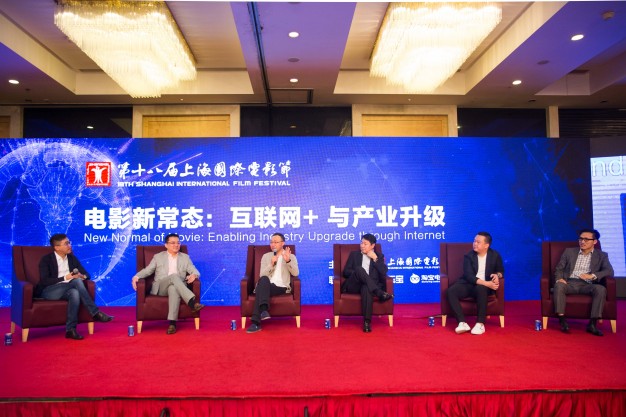
SHANGHAI June 14, 2025 - Chinese filmmakers need to get over their fear of Internet companies and accept the Internet as the way of the future because no matter how powerful they are, they would not be able to provide great content by themselves. So for traditional film studios, the best thing or maybe the only thing left to do is to produce high-quality content. That is the view of Yu Dong, President of Bona Film Group Limited, at a panel discussion during the 18th Shanghai International Film Festival. Reported by Hua Yang.
Yu and four other industry insiders including Lin Qi, CEO and Chairman of Youzu; Liu Chunning, CEO of Alibaba Digital Entertainment Group and Wang Changtian, Chairman of Enlight Media, addressed the issue at the panel.
Good content will always survive
“Chinese film market is experiencing a second-stage revolution. The Internet is building a new ecosystem within the industry. When the market’s vulnerability meets strong capital, the industry could turn toward the negative if we no longer focus on the content. People may just shoot short videos or fan-oriented films to gain profits. As long as traditional film companies focus on content creation when the Internet upgrades the industry chain, they will not be replaced. Instead, they could make a big difference in the industry,” Yu explained.
At last year’s panel, Yu said that all film companies would eventually work for BAT (Baidu, Alibaba and Tencent). But this year he revealed that Bona is in no hurry to get a deal with BAT as creating more good content is now their primary goal. “In the end, only high-quality content can act as an attention-getter and a bargaining chip. Fan-oriented films or those rely on popular icons do not stand up,” he said.
Chinese film market’s promising future
On the contrary, Enlight has already been in partnership with Alibaba. Alibaba purchased a 2.4 billion yuan ($383 million) stake in Enlight this March, becoming the company’s second largest shareholder, and signed a three-year framework agreement with Enlight in May, aiming to create a new business model for filmmaking.
“I met Jack Ma twice before accepting the investment. He told me that generally he would not meet the other party if the investment were less than 3 billion yuan ($480 million). But he was concerned about how to get the Chinese film market to 300 billion yuan ($48 billion),” Wang said.
Both Yu and Wang believe the film industry in China is developing fast with very promising market potential. Yu expects the 26 films that Bona is going to invest in the next one and half years will make a total box office of 10 billion yuan ($1.6 billion) while Wang feels that Enlight itself could have more then three films collecting over 1 billion yuan ($160 million) in terms of box office and five or six making more than 500 million yuan ($80 million) in 2015. Enlight’s online video site will also be launched this summer.
Moreover, Wang expected it would only take a few years for China’s film industry to achieve what Hollywood did in the past few decades. “Hollywood is no longer at its golden age. It has low efficiency and cliché patterns. The low budget films are sometimes even worse than us while those big deals cost way too much. If China’s films spend that much on a film, we may make better films than them,” he said.
“Chinese film market varies and scatters over extensive areas, many of which can also compete with those in Hollywood. Take LOST IN HONG KONG for example; if it were in 3D, its box office would achieve a Hollywood level. But since it is not, its revenue will be around 2 billion yuan ($320 million),” Yu added.
Internet upgrades the industry
From a historical perspective, Lin said the film industry’s current situation reminded him of what the game industry was six years ago. “At that time, people were all talking about how the Internet would change the game market. And here we are. After six years, what the Internet has brought is a new kind of entrepreneurship that insists on putting users first. I think the Internet is doing the same to the film industry,” he said.
And specifically, Liu believed with the Internet distribution, there would be landmark developments in the way people watch films. “Theater will not be the one and only player in the market anymore. Home entertainment may soon take the lead as the Internet gives them more power to watch films when and how they choose,” he added.
“There was a narrow path to get a career in film. Most people failed to make films without good networking. But now the Internet has radically changed how it works. It makes it much easier for people to get their video project seen or their novels read. As a result, thousands of filmmakers and IP owners can get a fair chance,” Wang said.

Related articles




More in this category